Monday, May 5, 2014

Literacy and Power in the Ancient World


Literacy and Power in the Ancient World

Literacy and Power in the Ancient World edited by Alan K. Bowman and Greg Woolf was published by Cambridge University Press in 1994 (hardcover) and 1996 (paperback). In 2005 it was transferred to digital printing, which means it is still available.

First a few words about the editors:

** Alan K. Bowman was, at the time of publication, a lecturer in ancient history, University of Oxford. I can add the following information: he is the author of several books, including Life and Letters on the Roman Frontier: The People of Vindolanda (first edition 1994, second edition 1998, third edition 2003).

** Greg Woolf was, at the time of publication, a fellow of Brasenose College, University of Oxford. I can add the following information: he is the author of Becoming Roman: The Origins of Provincial Civilization in Gaul (hardcover 1998, paperback 2000) and the co-editor of Ancient Libraries (2013).

The papers presented in this volume are the product of a conference held at Oxford in 1992. This volume contains 13 contributions by 12 classical scholars, including the editors. Here is the table of contents [the affiliation of each scholar at the time of publication is added in square brackets]:

CHAPTER 1
Literacy and power in the ancient world
By the editors

CHAPTER 2
The Persepolis Tablets: speech, seal and script
By D. M. Lewis
[Christ Church, Oxford]

CHAPTER 3
Literacy and the city-state in archaic and classical Greece
By Rosalind Thomas
[Royal Holloway, University of London]

CHAPTER 4
Literacy and language in Egypt in the Late and Persian Periods
By John Ray
[Selwyn College, Cambridge]

CHAPTER 5
Literacy and power in Ptolemaic Egypt
By Dorothy J. Thompson
[Girton College, Cambridge]

CHAPTER 6
Power and the spread of writing in the West
By Greg Woolf

CHAPTER 7
Texts, scribes and power in Roman Judaea
By M. D. Goodman
[Oriental Institute and Wolfson College, Oxford]

CHAPTER 8
The Roman imperial army: letters and literacy on the northern frontier
By Alan K. Bowman

CHAPTER 9
Literacy and power in early Christianity
By Robin Lane Fox
[New College, Oxford]

CHAPTER 10
Greek and Syriac in Late Antique Syria
By S. P. Brock
[Oriental Institute and Wolfson College, Oxford]

CHAPTER 11
Later Roman bureaucracy: going through the files
By C. M. Kelly
[Pembroke College, Cambridge, and Royal Holloway, University of London]

CHAPTER 12
Literacy and power in the migration period
By Peter Heather
[University College, London]

CHAPTER 13
Texts as weapons: polemic in the Byzantine dark ages
By Averil Cameron
[King’s College, London]

References are given in footnotes at the bottom of the page (very user-friendly). At the end of the book we find a bibliography - divided into 13 sections, one for each chapter (also very user-friendly) - and an index.

What about illustrations? There are only five pictures in black-and-white. Since the number is so low, I can mention all of them here:

** Figure 1 – A tablet from Persepolis in Elamite language and modified Akkadian cuneiform (page 22)

** Figure 2 – A demotic papyrus showing an initial year sign (page 81)

** Figure 3a – Vindolanda tablet II 248: a letter from Niger and Brocchus to Flavius Cerialis (page 114)

** Figure 3b – Vindolanda tablet II 181: a cash account from Vindolanda (page 115)

** Figure 4 – Chamber in the Sphendone of the Hippodrome at Constantinople (page 162)

The number is rather low and so is the quality, in particular figure 4. It would have been nice to have more illustrations. Since this book is about reading and writing in the ancient world, the contributors could (and should) have shown us what this writing looked like. They present and discuss many ancient inscriptions, but in most cases they do not show them: a missed opportunity.

This volume is not a general history of the ancient world. The authors assume the reader has a basic knowledge of this subject. Therefore this volume is not recommended for the beginner.

If, on the other hand, you are already familiar with the subject and you wish to learn about the topics discussed here – literacy and power in the ancient world – then this collection may be the right one for you.

When you read the papers presented here, you will get a chance to see how a classical scholar can work. You will get a chance to find out what we how and how we know it; or (in some cases) how little we know, because the evidence is quite limited.

As you can see from the table of contents, this book covers the Mediterranean world and much of northern Europe during a period of more than a millennium (from ca. 600 BC to ca. AD 800). For the record: Asia is not included. There is nothing about the ancient history of China or Japan.

The authors deploy an impressive range of materials: inscriptions written on stone and bronze, tablets of wood and lead, and coins, as well as graffiti written on walls and pottery.

The authors are careful. They do not jump to conclusions. They present and discuss the ancient evidence as well as relevant modern scholarship. When they draw a conclusion, it is based on the evidence and not on speculation.

Bowman and Woolf got some good reviews: on the back cover of the paperback version there are excerpts from two reviews of the hardcover version:

** The Classical Review: 

“Bowman and Woolf’s collection has many virtues – not least putting Greek and Roman experience into a wider ancient context. All classicists must read it to broaden their range and enlarge their operating framework.”

** JACT Review: 

“This book is highly informative and always interesting.”

[The four letters JACT stand for: Joint Association of Classical Teachers]

If you ask me, the positive reviews are justified. I like these essays. I like, in particular, chapter 9 “Literacy and power in early Christianity” by Robin Lane Fox, who has a lively style of writing.

Cyprian of Carthage, whose full name is Thascius Caecilius Cyprianus, is presented in this chapter (pp. 135-139). He was born around AD 200; he was bishop of Carthage from 249 and died as a martyr in 258. Fox talks about “the richest of all our sources, the letters preserved in Cyprian’s correspondence, radiating in and out of Carthage in the 240s and 250s.” He adds: “G. W. Clarke’s admirable edition helps historians to see literacy and power at work in a major bishop’s life.”

Clarke’s edition of Cyprian’s letters was published in four volumes 1984-1987. Since Fox wrote his essay, new studies of the man and the role he played have appeared: Cyprian the Bishop by J. P. Burns Jr. was published in 2001; Cyprian and Roman Carthage by Allen Brent was published in 2010; and The Complete Works of Saint Cyprian of Carthage edited by Philip Campbell was published in 2013.

Caesarius of Arles is also presented in this chapter (page 146). He was born in 468/469/470. Fox writes: “in the early sixth century, Caesarius, bishop of Arles from 503 to 543, was a tireless circulator of sermons and texts, excelling even Cyprian and leaving a lasting mark on the complex manuscript tradition of his own writings.”

Since Fox wrote his essay, a new study of the man and the role he played has appeared: Caesarius of Arles: The Making of a Christian Community in Late Antique Gaul by William E. Klingshirn (Cambridge University Press, hardcover 1994, paperback 2004); see also Caesarius of Arles: Life, Testament, Letters edited and translated by William E. Klingshirn (Liverpool University Press, 1994).

Incidentally, Cyprian is listed in the index, but Caesarius is not. He is considered a minor character. In my opinion, he deserves to be mentioned. This is one case where the index is incomplete.

Literacy and Power in the Ancient World is an academic work: not suitable for the beginner, but recommended for the serious student. The editors have produced an important contribution to modern scholarship about the history of the Roman Empire and some of its neighbours. Sadly, there is a negative point: as stated above, the number of illustrations is rather low, and so is their quality.

PS. For more information about this topic, see the following publications from the Journal of Roman Archaeology: Literacy in the Roman World, special supplement # 3, 1991, and Becoming Roman, Writing Latin? special supplement # 48, 2002. Bowman is a contributor to the former, while Woolf is a contributor to the latter.

* * *

Alan K. Bowman and Greg Woolf,
Literacy and Power in the Ancient World,
Cambridge University Press, hardcover 1994, paperback 1996,
Transferred to digital printing in 2005, 249 pages
 
* * *


Friday, May 2, 2014

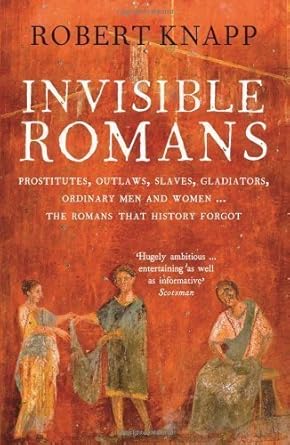
Invisible Romans by Robert Knapp


Invisible Romans is a book about the people, who were not members of the rich and powerful elite (hardcover 2011, paperback 2013). The author - Robert Knapp - is Professor Emeritus of ancient history at the University of California, Berkeley.

Following a brief introduction, the main text is divided into nine chapters, which cover nine categories of invisible Romans. Each chapter is divided into several shorter sections by subheadings. Here is the table of contents:

1. Ordinary People - Men
2. Ordinary People - Women
3. The Poor

4. Slaves
5. Former Slaves: Freedmen and Freedwomen
6. Soldiers

7. Prostitutes
8. Gladiators
9. Bandits and Outlaws

At the end of the book there are nine short sections:

** Sources
** Further Reading
** Who’s Who and What’s What

** Abbreviations
** Note on Translations
** Acknowledgements

** List of Figures
** List of Illustrations
** Index

There are two sets of illustrations: 32 black-and-white figures are placed throughout the book, while 30 colour pictures are placed in a block in the middle of the book.

During the first century AD, the population of the Roman Empire was ca. 50 million, but the elite comprised less than one million - or less than one per cent - of the total population. We know (some members of) the elite fairly well, but Knapp does not want to write about them. His topic is the unknown majority, “the Romans that history forgot.” He wants to study and understand not only their lives but also their thoughts, their hopes and dreams, what he terms their “mind world” – a noble ambition, which is difficult to fulfil.

The short section about sources is placed at the end of the book, as you can see from the list above. Perhaps it should have been placed in the beginning of the book, because here the author explains his choice of sources, and the reader needs to understand this choice from the start.

Elite sources are avoided, but they are not entirely absent: Cicero is quoted on outlaws (pp. 306, 308-309); Tacitus is mentioned, because he reports that the Roman senator Pedanius Secundus was murdered by his slaves (pp. 142-143, 145-146); and Horace is mentioned, because his father was a freedman (pp. 182-183).

Sources about poor people in Rome are avoided as well, because the capital was not a typical place, as explained on page 101: 
 
Rome and its population was an aberration in the empire both for its size and for its political importance as the immediate milieu of the governing class.”

To find information about the invisible Romans Knapp uses a number of untraditional sources, such as “Interpretation of Dreams” by Artemidorus, “Carmen Astrologicum” by Dorotheus of Sidon, and “The Golden Ass” by Apuleius.

Epigraphic material is used as well, for instance the tombstone for Aurelius Hermia, a butcher from Rome, and his wife Aurelia Philematio. I like this tombstone. The author seems to like it as well: the inscription is quoted two times (pp. 55 and 188); and a black-and-white picture of the tombstone appears on page 62 (figure 3).

[For more information about this tombstone see Mary Beard, “Reading the Romans,” British Museum Blog, 25 April 2012.]

Knapp got some good reviews. On the cover of the paperback version there are excerpts from three positive reviews of the hardcover version:

** The Scotsman: “Hugely ambitious … entertaining as well as informative.”

** The Daily Express: “This unusual and scholarly book is rich with revelation.”

** The Irish Examiner: “A good, lively read. Knapp shows the Roman world to be more colourful and varied than we might expect.”

I agree with most of this, but not everything. This book is informative but not entertaining, as the Scotsman claims; it is scholarly but not a lively read, as the Irish Examiner claims. The project is worth while, but the author is not entirely successful.

Tristan Taylor (from the University of New England, Australia) reviewed the book for the online magazine Bryn Mawr Classical Review (2012.07.03). In general, his review is positive, but there are some critical remarks:
 
(1) Knapp could have used legal sources more than he does. As an example Taylor mentions Lives behind the Laws by S. Connolly (published in 2010).
 
(2) Knapp fails to use his own illustrations in full, because there are no cross-references from the colour illustrations to the text (or the other way).

The review ends with the following words: 
 
“All in all, this is an elegantly written, stimulating and revealing introductory account of the ‘mind world’ and practical lives of those largely ‘invisible’ to us in the elite sources.”

Knapp is aware of the problem mentioned in Taylor’s review. Regarding legal sources (page 320), he claims they do not throw much light on the topic: “the interaction of invisibles with the law is not as fruitful as one would have expected.”

Regarding Jewish literature (page 321) and archaeological evidence (page 323), he admits this material was not used to the full extent: 
 
“Perhaps another [scholar] more versed in the material will be able to add to or correct the observations I make.”

I like this book, but I have to mention a few minor flaws. I mention them here to show how carefully I read the book:

(A) The question of literacy is mentioned on page 204, but this important topic not discussed again. For more information, see Literacy in the Roman World (1991).

(B) The evidence from Vindolanda – the Roman fort near Hadrian’s Wall in northern England – is mentioned on the same page, but this unique evidence is not discussed again. For more information, see Life and Letters on the Roman Frontier: Vindolanda and its People (1994).

(C) There is a chapter about one group of entertainers, the gladiators who performed in the amphitheatre, but two groups are missing: the actors who performed in the theatre and the charioteers who performed in the circus.

(D) Knapp thinks a complete Roman legion consists of 6,000 men (page 198). It is a common misunderstanding. A more accurate figure is ca. 4,800 men.

My conclusion: this book is good, but not great. This means four stars, not five.

* * *
 
Robert Knapp,
Invisible Romans:
Prostitutes, Outlaws, Slaves, Gladiators, Ordinary Men and Women…
The Romans that History Forgot,
Profile Books, hardcover 2011, paperback 2013, 371 pages

* * *


Wednesday, April 16, 2014

Tokyo: A Lonely Planet Guidebook (2012)


Lonely Planet Tokyo 9th Ed.: 9th Edition: Lonely Planet, Hornyak ...


The ninth edition of Lonely Planet’s guidebook for Tokyo – written by Timothy Hornyak and Rebecca Milner - was published in August 2012. The book is divided into four main sections. Here is a brief overview:

** Section 1: Plan Your Trip
There are 14 chapters in this section, including the following: Eating, Drinking & Nightlife, Entertainment, and Shopping

** Section 2: Explore Tokyo
There are 15 chapters in this section, including the following: Day Trips from Tokyo and Sleeping

** Section 3: Understand Tokyo
There are 6 chapters in this section, including the following: History, Arts, and Architecture

** Section 4: Survival Guide
There are 3 chapters in this section: Transport, Directory A-Z, and Language. In addition there is a general index plus six sub-indexes.

Twelve maps at the end of the book cover different areas of the city. The book comes with a pull-out map: on one side a map of central Tokyo; on the other side a map of the Tokyo subway (a subway map is very important; you will not be able to get around in Tokyo without consulting this map, again and again).

This book tells you what to see and what to do when you are in Tokyo. It gives you information about restaurants and hotels and about how to get around in Tokyo.

It presents the majors sights of Tokyo, for instance Meiji Jingu (a Shinto shrine, page 116), Senso-ji (a Buddhist temple, page 168-169), Tokyo Tower (an old monument, page 82), and Tokyo Sky Tree (a new monument, page 170).

I had it with me on a recent trip to Japan. During this trip I was able to test the quality and the value of the information in the book. In my opinion, it is helpful and useful. But there are some flaws. In addition, there are some cases where the information given should be expanded and/or updated. Here are some examples:

*** Regarding smoking:

“The majority of Tokyo’s night spots allow smoking” (page 45).

This is true, but not the whole story. Many restaurants and coffee shops are divided into 2 sections, one for smokers and one for non-smokers. Almost half the space of the place may be devoted to smokers, even if there are only 2 or 3 of them present. Consequently, the space for non-smokers is limited. Sometimes you will have to wait in line, because the non-smoking section is full, while the smoking section is almost empty. What about the staff? They must work in both sections! In some respects Japan is a very modern society. But in other respects it is very old-fashioned. This topic is a case in point. Lonely Planet should give us the whole story about smoking in Japan.

*** Regarding tips:

“Despite the high quality of customer service in Japan, it is not customary to tip” (page 261).

This formulation is not quite accurate. Tipping is simply not accepted. It seems tipping is regarded as an insult. Lonely Planet should be more precise.

*** How to call the waiter in a restaurant:

In the western world we look up and try to catch the waiter’s attention. Sometimes we raise our arm and wave it. We are not always successful. In Tokyo there is a modern solution to this problem: many restaurants have a small device on the table. It is an electronic bell. When you are ready to order, just press the bell. The waiter can see which table is calling, and he will show up at your table. This system seems to be quite common in Tokyo (but we did not see it in Kyoto). Lonely Planet does not mention this system.

*** Regarding Tokyo Sky Tree:

This monument is presented on page 170. There is a picture of it on page 173. The information about this monument is very brief, perhaps because the tower opened in May 2012, just before the deadline of the book expired. In addition, the prices have been raised since the book was published. Here are the current prices:

* Platform one = pay 2,060 yen
* Platform two = pay an additional 1,030 yen

The tower is very popular. This means you cannot just walk in and buy a ticket. On a busy day, there is a complicated system for buying your ticket:

(1) Stand in line to get a numbered card with a time slot
(2) When the time has come, stand in line to buy your ticket to platform one
(3) Stand in line to enter a lift to platform one
(4) Take the lift to platform one

If you wish to go further, you must complete the following steps:

(5) Stand in line to buy a ticket to platform two
(6) Buy your ticket
(7) Stand in line to enter a lift
(8) Take the lift to platform two

When you wish to return to the ground, the process is reversed, although you do not have to buy a ticket to go down.

If you want to visit the tower on a busy day – i.e. a day with nice and clear weather – you must be prepared to spend 3-4 perhaps even 5-6 hours on a visit to this monument, which is at the moment the tallest tower in the world. If you ask me, the view from platform two is not better than the view from platform one. My advice: go to platform one. Do not bother with platform two. Save your time and money for something else.

*** Regarding transport in Tokyo:

This topic is covered on pp. 252-257. The reader is advised to buy a special card which can be used on the subway and the bus in the Tokyo area: the Passmo card, issued by the subway, and the Suica card, issued by JR. This advice is sound. On page 256 we are told: “You can replenish the value of the cards as needed at stations.”

This is not quite accurate. In the subway, you can always top up a Passmo card. But you cannot always top up a Suica card, because the machine by the exit will not accept it. In some stations there are two machines: one for the Passmo card, and one for the Suica card. If you have the Suica card, be sure to top up when you see a machine that accepts the card. Otherwise you will have a problem, if your balance is too low to pay your fare. Lonely Planet does not give you this warning.

Incidentally, the Suica card can also be used on the subway in Kyoto, but for some reason it is not valid on the bus in Kyoto.

[For more information about Kyoto, see Kyoto: A Lonely Planet Guidebook.]

*** Regarding the Yakusini Shrine:

This (highly controversial) monument is covered on page 141. Behind the main building there is an area which is sometimes used for sumo-wrestling. When we were there, we noticed that many visitors walked to the right of the main building and then disappeared. When we followed them, we came to the sumo-wrestling area where a large audience was watching a large group of sumo-wrestlers. Clearly, the Japanese knew of this event. Access was free. Personally I am not fond of this sport, but it is a part of Japanese culture and history. Sumo-wrestling is mentioned on pp. 170-171 in connection with another location. Lonely Planet does not mention the area behind the Yakusini Shrine.

*** Regarding Tokyo National Museum:

This place is presented on page 158. The authors say: “If you visit only one museum in Tokyo, make it this one.” I agree. This is a great museum. It is an excellent choice on a rainy day. The prices listed in the book need to be updated: an adult must now pay 620 yen, while a student must now pay 410 yen. A senior and a child may enter for free, but Lonely Planet does not tell us how these categories are defined. An adult is 70 years and older, while a child is younger than 18.

What about a camera? Can I use a camera inside the museum? Lonely Planet does not say anything about this topic. I am happy to tell you that you are allowed to use a camera inside the museum (but no flash and no tripod).

*** Regarding the Tsukiji Fish Market:

This place is described on pp. 68-69. It is presented a one of the top sights in Tokyo. But the attraction of this sight is overrated, and the information given in the book is misleading.

The text says the main action takes place between 5 and 8 AM. Therefore the reader is advised to show up early. We arrived one morning at 7 AM. When we tried to enter a hall, we were told to go to the next hall. When we tried to enter the next hall, a local guard walked up to us and showed us a sign which said in English: “Do not enter this area before 9 AM.” He told us to get out. Not only that. He followed us all the way to make sure that we actually left the place. When we wanted to stop for a second to take a picture, he shouted: “No pictures!”

Many Japanese are very polite and friendly with foreigners. This guy was not one of them.

The next day we returned to the marked after 9 AM. There was nothing much to see. My advice: The Namiyoke Inari Shrine next to the market is an interesting place. Do not waste your time on the fish market.

*** Regarding Senso-ji:

This temple is presented on pp. 168-169. Regarding transport to the temple the reader is told to take the Ginza line to Asakusa station and to use exit # 1. In fact the correct exit is # A4.

*** Regarding maps:

(a) There is no map of Japan in this book. I would like to see where Tokyo is in relation to the rest of the country.

(b) The 12 maps of different areas of Tokyo do not touch each other. This means several areas of the city are not covered by any map.

(c) The fold-out map covers only the central part of Tokyo. Lonely Planet should give us a better (i.e. a more comprehensive) map than this.

I have written to Lonely Planet to tell them about these flaws. I hope they will be corrected in the next edition of the guidebook.

* * *
Timothy Hornyak and Rebecca Milner,
Tokyo: Lonely Planet,
Ninth edition, August 2012, 304 pages 
* * *


Tuesday, April 15, 2014

Kyoto: A Lonely Planet Guidebook (2012)


Lonely Planet Kyoto


The fifth edition of Lonely Planet’s guidebook for Kyoto – written by Chris Rowthorn – was published in February 2012. The book is divided into four main sections. Here is a brief overview:

*** Section 1: Plan Your Trip
There are 15 chapters in this section, including the following: Eating, Drinking & Nightlife, Entertainment, Shopping, plus Temples & Shrines

*** Section 2: Explore Kyoto
There are 11 chapters in this section, including the following: Day Trips from Kyoto and Sleeping

*** Section 3: Understand Kyoto
There are 6 chapters in this section, including the following: History, Arts & Crafts, Architecture & Gardens, plus the Tea Ceremony

*** Section 4: Survival Guide
There are 3 chapters in this section: Transport, Directory A-Z, and Language. In addition there is a general index plus six sub-indexes

Nine maps at the end of the book cover different areas of the city. The book comes with a pull-out map: on one side a map of central Kyoto; on the other side a map of the Kyoto transport system (such a map is important; you will not be able to get around in Kyoto without consulting it).

This book tells you what to see and what to do when you are in Kyoto. It gives you information about restaurants and hotels and tells you how to get around in Kyoto.

It presents the majors sights of Kyoto, for instance:

* Kyoto Tower – page 51
* Nishiki Market – page 56
* Kyoto Imperial Palace Park – page 71


* Fushimi-Inari-Taisha Shrine – page 76
* Kiyomizu-dera Temple – page 81
* Nanzen-ji – page 94


* Ginkakuji – “the Silver Pavilion” – page 95
* Kinkakuji – “the Golden Pavilion” – page 106
* Nijo Castle – page 107

I had it with me on a recent trip to Japan. During this trip I was able to test the quality and the value of the information in the book. In my opinion, it is helpful and useful. But there are some flaws, and some information needs to be updated:

** Visiting Kiyomizu-dera. How can I get there? Lonely Planet tells me to take bus # 100 or # 202 from Kyoto Station. The correct numbers are 100 and 206.

** Visiting Nanzen-ji. How much must I pay to enter the Hojo Garden and the San-mon Gate? Lonely Planet says I must pay 500 yen to enter the former and 300-400 yen to enter the latter. The correct fee is 300 yen for the garden and 500 yen for the gate.

** Public transport: on some buses you pay a flat fare, i.e. the fare does not depend on the distance that you travel. Lonely Planet says the fare is 220 yen. But the price has been raised since the book was published, and now it is 230 yen.

** You can use a Suica card on the subway in Kyoto, but for some reason it is not valid on the bus in Kyoto. The Suica card, which is issued by JR, can be used on the subway and bus in Tokyo. Chris Rowthorn does not mention the Suica card in his section about local transport (pp. 184-189).

** Taxes and refunds: on page 195 we are told: “There is a 5 % consumption tax on retail purchases in Japan.” In the spring of 2014 this tax was raised to 8 per cent, which means the price of (almost) everything went up.

** The Byodo-in Temple in Uji is presented on pp. 125-126. In September 2012 the Phoenix Hall of this temple was closed down for a renovation project which lasted one and a half year. In April 2014 the hall was opened to the public again. The Phoenix Hall, which is depicted on the Japanese 10 yen coin, can accept up to 50 visitors at a time. Each tour is limited to 20 minutes. Admission to the hall is 300 yen, on top of the regular admission to the temple area, which is 600 yen. Obviously, this renovation project is not mentioned in the book, since it began after the book was published.

** While presenting the Fushimi-Inari-Taisha Shrine, the author mentions a pathway that runs for ca. 4 km around the mountain, but fails to give any details about it. The reader needs to know the following: the route from the main shrine to marker # 6 can be completed in ca. 30 minutes. At this point a circular route begins (and ends). The circular route comprises markers # 8 to # 17. The circular route can be completed in ca. 60 minutes (clock-wise or counter-clockwise). The route from marker # 6 and back to the main shrine can be completed in ca. 30 minutes.

In other words: You can complete the whole trail in ca. 2 hours, depending on how fast you walk.

The author should provide more information about the pathway. In addition, he should provide a map which shows the route around the mountain, so the reader knows what he or she is in for.

** The Toji Temple is mentioned in a brief sentence on page 51: “Even near Kyoto Station, you’ll see the lovely pagoda at Toji temple…”

One sentence! That is all. How can the author think this is enough? Moreover, the description of the location is a bit odd. The temple is not exactly “near Kyoto Station.” It is located southwest of the station: ca. 2 km to the south and ca. 2 km to the west.

This temple – one of the oldest and most important in Kyoto - deserves a proper presentation. Furthermore, the location of the temple should be shown on one of the maps in the book.

Having made these critical comments I would like to add some positive words as well:

(1) On page 30 there is a brief paragraph on tipping: “There is no tipping in restaurants or cafes.” This is true. I wish to praise the author for this message: it is short and clear - and accurate. Tokyo: A Lonely Planet Guidebook says tipping is “not customary,” which is not accurate. It seems the author of the Kyoto book is better informed than the authors of the Tokyo book.

(2) On pp. 191-192 there is a section about the internet and how to go online in Kyoto. The author issues a warning here: perhaps it is not as easy as you think. There is wi-fi almost everywhere, but in most cases it is not free. I wish to praise the author for giving this warning. It is good to know and good to be prepared. One way to deal with this matter is to make sure you always choose a hotel that offers free wi-fi. We followed this approach and we were not disappointed. Every hotel we stayed in had wi-fi, it was free, and it worked well.

(3) On page 193 there is a section about how to pay in Kyoto: with cash or with a credit card. The author issues a warning here: “Japan is a cash society!” Credit cards are only accepted in expensive hotels and department stores. Always carry enough cash to pay for what you need. I wish to praise the author for giving this warning. It is good to know and good to be prepared. One way to deal with this matter is to make sure you always choose a hotel that accepts credit cards. It does not have to be a five star hotel. Before you enter a restaurant, ask if they accept credit cards. If they do not, find another venue that does. During our stay in Japan I was surprised to see that many places – even small establishments - were in fact ready to accept my credit card. But this was a good surprise, not a bad surprise.

(4) On page 52 the author tells us that if you go to floor 11 of Kyoto Station building you will find a fine collection of restaurants, not only Japanese, but also Korean and western style. You would never guess this when you are standing on the ground floor of this building.

On the same page the author mentions Yodobashi Camera, a tall building located a few minutes’ walk north of Kyoto Station. On floor 8 of this building there is another fine collection of restaurants. You would never guess this when you are standing in front of the building.

I wish to praise the author for providing this valuable information about where to go for dinner.

I have written to Lonely Planet to tell them about the negative and positive elements I have found in the book. I hope the flaws will be corrected in the next edition.

How many stars does this book deserve?

It is obvious to compare this book about Kyoto with Lonely Planet’s book about Tokyo. In both volumes I see some positive and negative elements, but when I compare them, I think the flaws of the latter are more serious than the flaws of the former. Therefore I will give the Kyoto book a rating of five stars.

* * *
Chris Rowthorn,
Kyoto: Lonely Planet,
Fifth edition, February 2012, 232 pages
* * *


Tuesday, March 18, 2014

Bandits in the Roman Empire: Myth and Reality


Bandits in the Roman Empire: Myth and Reality by Thomas Grűnewald is an English version of a book that was published in German in 1999. The English version was published by Routledge in 2004 (hardcover) and 2008 (paperback). The text is translated by John Drinkwater, a classical scholar from the University of Nottingham and author of Roman Gaul (1983, reprinted 2013).

Thomas Grűnewald - a classical scholar from Germany - is the author of a book about political propaganda in the age of Constantine (published 1990). His book about bandits in the Roman Empire began as a doctoral dissertation (Habilitation) for the Faculty of Arts and Social Sciences at the Gerhard-Mercator University in Duisburg. The text has been slightly revised for publication in order to accommodate comments made by examiners. According to the back cover of the paperback version he is an honorary lecturer in Ancient History at the University of Duisburg-Essen.

The Latin word for a bandit is latro, plural latrones. For obvious reasons this word is used a lot in this book. The Greek equivalent is laistes, plural laistai. Bandits on the sea (pirates) are known as praedones. While these words have several meanings, they always have a negative connotation.

The book begins with an introduction where ancient sources and modern scholarship about the topic are presented. It is no surprise that the primary material is quite limited. Most ancient authors felt that bandits do not deserve to be mentioned or discussed in serious literature. They are only mentioned in passing or if the author has a special agenda: it seems Tacitus mentions bandits during the reign of Tiberius in order to place this emperor in a bad light. The secondary material is also quite limited. An important source of inspiration is Bandits by E. J. Hobsbawm (1917-2012) (first published 1969, fourth edition 2001). Modern works are listed in a brief bibliography that appears on pp. ix-x.

The following text is divided into 8 chapters. Each chapter is divided into shorter sections by subheadings, which is very user-friendly. Here is the table of contents [with some additional information in square brackets]:

* Chapter 1 – Real bandits

* Chapter 2 – Guerrilla leaders as latrones
[Viriathus, Sertorius, Tacfarinas]

* Chapter 3 – Leaders of slave revolts as latrones
[Eunous and Cleon, Salvius and Athenion, Spartacus]

* Chapter 4 – Politicians and pretenders as latrones
[Catilina, Clodius, Julius Caesar, Marcus Antonius, Sextus Pompeius]
[Zeniketes, Lysias, Tarcondimotus, Antipater, Cleon]
[Lachares, Eurycles, Zamaris]
[Maxentius, Magnus Maximus, Maximinus Thrax]
[Proculus, Lydius, Palfuerius]

*Chapter 5 – Leistai in Judaea
[John of Gischala, Simon bar Giora]
[The mass suicide of the Sicarii at Masada]

* Chapter 6 – Imperial challengers
[Bulla Felix, Isodorus, Maternus]

* Chapter 7 – Avengers in dynastic conflicts
[Clemens, avenger of Agrippa Postumus]
[The avenger of Drusus, son of Germanicus]
[The avenger of Alexander, son of Herod]
[Aedemon, avenger of Ptolemy of Mauretania]
[Anicetus, avenger of Polemon II of Pontus]
[Three false Neros]
[Three troublemakers of the late Republic]

* Chapter 8 – Conclusion

At the end of the book there are notes with references and additional comments as well as an index. A note on page 222 explains: “This index combines Indices 3 and 4 of the German edition. Indices 1 and 2, listing citations of ancient and modern authors, have been omitted.”

While the text is relatively short (166 pages, including introduction and conclusion), the notes are quite extensive. They cover more than fifty pages (167-221). The top of the left-hand pages repeat the title of the book, while the top of the right-hand pages are marked with one word: “Notes.” This is unfortunate and not very user-friendly. The top of the left-hand pages should have been marked “Notes to chapter NN,” while the top of the right-hand pages should have been marked “Notes to pages XXX-YYY.”

There are no illustrations in this book. A photo on the front cover shows a relief of a mounted city policeman (paraphylax) and his armed subordinates. It is from Izmir (Smyrna), Turkey. Incidentally, this motive was also used on the front cover of Enemies of the Roman Order by Ramsey MacMullen (1966).

According to Grűnewald, the bandits of the Roman Empire can be divided into four types:

** Type-One: Robbers - chapter 1
** Type-Two: Rebels - chapters 2-3
** Type-Three: Rivals – chapters 4-6
** Type-Four: Avengers – chapter 7

The title of the German version contains four alliterations with the letter R: Räuber, Rebellen, Rivalen, Rächer. As you can see, these German words correspond to the four types of bandits identified by the author.

According to Grűnewald, each type can be divided into two sub-types, one negative and one positive. Among the rebels, Tacfarinas is considered a common criminal, who only wants to enrich himself, while Viriathus is considered a noble bandit, because he has a higher goal, such as justice. Among the rivals, Maternus is regarded as a common criminal, while Bulla Felix is regarded as a noble bandit.

As far as I can see, the sub-types (one negative and one positive) do not work well with type-one or type-four bandits.

While there are four types, the lines between them are not always clear: Viriathus, who is presented as a rebel, might also be described as an avenger. Even Octavian, the future Emperor Augustus, might be described as an avenger, who wanted to revenge the murder of his adoptive father, Julius Caesar.

Grűnewald is aware of this fact. On page 138 he says: “… to a certain extent the desire for vengeance characterises all types of latrones, in this respect making it difficult to distinguish between them.”

The German version (published 1999) was reviewed by Brent D. Shaw in the online magazine Bryn Mawr Classical Review (2000.02.12). Shaw knows the topic quite well: he is the author of three articles about Roman bandits (published 1984, 1991 and 1993). All three articles are listed in Grűnewald’s bibliography, and there are several references to them in the notes. Shaw is also the author of Sacred Violence: African Christians and Sectarian Hatred in the Age of Augustine (2011).

It is, in many ways, a positive review. Having presented a brief summary of the book, Shaw says:
 
“Grűnewald has worked carefully and assiduously to correct and update existing studies (…), and he is a fair and accurate reporter of views of other scholars on the subject. His analysis of the primary and secondary materials for the history of brigandage in the Roman empire is both diverse and comprehensive.”

At the end of his review, Shaw describes the book as “a diligent and incisive summa of research done to date, and a reasoned critique of some superficial interpretations that have worked their way into the scholarship on the subject. It will be the necessary point of departure for anyone who wishes to acquire an accurate assessment of the state of research, the condition and range of the primary sources and the specifics of the standard cases that have been involved in modern historical debates on the subject.”

However, Shaw also has some critical comments and some critical questions. Labels (definitions) can change over time, depending on the circumstances (i.e. who is in power):
 
“The novelists make the point that the bandits or pirates can be exterminated like beasts on one day, or rise to the position of respectable men and officials on another. Such was the work of fate.”

A modern example (not mentioned by Shaw) is Nelson Mandela: as a prisoner of the apartheid state, he was branded as a dangerous terrorist. When he was released and became the first black president of South Africa, he became the most respected politician in his own country and one of the most respected politicians in the entire world.

According to Shaw, the labels used by Grűnewald are not always convincing:
 
“Despite reading and rereading the section on the leaders of the slave wars as ‘type-two’ bandits, it remains unclear to me why Eunus [Eunous] and Athenaios [Athenion] count [as noble bandits] and Spartacus does not.”

Shaw has a question:
 
“Why precisely, for example, is Vespasian never a bandit to an observer like Josephus, who sees brigands everywhere else around him in his own society?”

I agree with Shaw. I like this book, but I have to mention a few things which bother me:

(1) On page 21 Grűnewald quotes an inscription from AD 151 or 152 about a person who was attacked by bandits as he travelled from Lambaesis to Saldae in North Africa. He says the author is Marcus Valerius Etruscus, but in fact it is Nonius Datus. Marcus Valerius Etruscus, commander of Legio III, did not travel to Saldae. He gave Nonius Datus, a Roman engineer, permission to make the journey.

The story of Nonius Datus and the aqueduct that transported water to Saldae is quite famous. It is mentioned in several books about Roman history. Apparently, Grűnewald does not know it. Apparently, the translator does not know it, either. He has faithfully translated Grűnewald’s mistake, without any correction.

For more information about this case, see Serafina Cuomo, “A Roman Engineer’s Tales,” Journal of Roman Studies, vol. 101 (2011) pp, 143-165.

(2) Sometimes Grűnewald is a bit careless when it comes to chronology. Here are some examples:

(A) In chapter 3 about the slave wars, he never provides the complete dates. On page 59, he should add: The First Slave War (Sicily, 135-132 BC).  On page 61, he should add: The Second Slave War (Sicily, 104-101 BC). On page 64, he should add: The Third Slave War (Italy, 73-71 BC).

(B) In the section about the Sertorian war in Spain (pp. 47-48), he never tells us when Sertorius was murdered. It happened in 72 BC. Incidentally, he never gives us the first name of this rebel. It is Quintus.

For more information about this conflict, see Sertorius and the Struggle for Spain by Philip Matyszak (2013).

(C) In the section about Tacfarinas (pp. 48-55), there is a problem with the chronology. We are told the conflict lasted from 17 to 24, which is true. On page 48 he says: “In AD 23 the proconsul Q. Junius Blaesus managed to run down and wipe out most of Tacfarinas’ followers.” In fact, this happened in AD 22. The text continues: “In the same year [i.e. AD 23] P. Cornelius Dolabella completed the work of his predecessor when he stormed the rebels’ camp and so precipitated Tacfarinas’ death.” In fact, this happened in AD 24.

When we get to page 53, we find the correct dates: Now Q. Junius Blaesus is connected with events in AD 22 and P. Cornelius Dolabella with events in AD 24. Apparently, the author did not notice his own inconsistency. Apparently, the translator did not notice it, either. He has faithfully translated Grűnewald’s mistake, without any correction.

(D) In the section about Masada, the desert fortress located south of Jerusalem and west of the Dead Sea (pp. 106-109), he says: “This last bulwark of the rebellion succumbed only in 73.” This is the traditional date. However, new evidence relevant for this case has been discovered, and therefore some scholars prefer the following year, AD 74. Grűnewald does not mention this issue. Perhaps he does not know about it. For references to the modern debate, see Maurice Sartre, The Middle East under Rome (2005) page 428 (note 204).

(3) Regarding Tacfarinas and his revolt, Grűnewald says: “Seen as a whole, it never amounted to very much, nor did it ever pose any serious threat to Roman rule in North Africa” (page 48).

Against this view I will offer the following facts, which are all mentioned by the author on page 53:

(a) The conflict lasted for almost ten years. (b) Three Roman commanders were granted a triumph after a victory over Tacfarinas. (c) The Ninth Legion was brought in from Pannonia to support the local legion in the war against Tacfarinas and his rebels.

On page 54 Grűnewald talks about “the very wide repercussions of Tacfarinas’ rebellion, its extraordinary ability to regenerate itself after defeat, the adaptability of its commander, his strategical [sic!] skills and his charismatic qualities as a leader.” Later, on the same page, he refers to “the undeniable truth that Tacfarinas’ uprising was perhaps the most important military event of the first ten years of Tiberius’ reign.”

As far as I can see, the first evaluation (on page 48) is refuted by the subsequent information (on pp. 53-54). The author seems to contradict himself, giving two opposing view of this rebellion.

(4) Sometimes Grunewald is so busy discussing terminology that he forgets to tell us the story of the bandits. This objection applies in particular to chapter 3 about the slave wars in the Republican era.

What about the translation? I think Drinkwater has done a good job. As noted above, it seems he overlooked a few problems. In addition, there are three misprints:

** Page 46 – “… the motions to refused Caepio his triumph.” It should be “refuse.”

** Page 79 – “Zenketes.” It should be “Zeniketes.”

** Page 100 – “Simon bar Gora.” It should be “Giora.”

In spite of these objections, I think he has done a good job. Because of his efforts this book is now available in English.

Incidentally, Drinkwater is mentioned in the text on pp. 129 and 164. There are references to his work in the notes on pp. 211-213 (notes 125, 149, 151).

Drinkwater was in contact with the author while he was working on the translation. In his foreword he explains: “I owe particular thanks to Thomas Grűnewald for his promptness and enthusiasm in reading and correcting my draft chapters as they were produced.”

In conclusion: Bandits in the Roman Empire is the first and so far the only full-scale study of this topic. I like this book, but as you can see from my review, there are some flaws, and therefore I think it deserves a rating of four stars.

PS # 1: The following recent articles are available online: Lincoln H. Blumell, “Beware of Bandits! Banditry and land travel in the Roman Empire,” Journeys, vol. 8, # 1-2, summer/winter 2007, pp. 1-20; Brady B. Lonergran, “Roman Banditry,” Penn Historical Review, vol. 18, # 1, fall 2010, pp. 1-25.

PS # 2: American author and illustrator Jasper Burns has written a modern screenplay about one of the famous bandits: Bulla Felix: The Roman Robin Hood (2011).

* * *
 
Thomas Grünewald,
Bandits in the Roman Empire: Myth and Reality,
Routledge, hardcover 2004, paperback 2008, 240 pages
 
* * *