
Rheinhotel Dreesen is a documentary film which premiered on German television (ARD) in October 2022.
It is a companion to a historical drama in two parts about this hotel which premiered on the same channel at the same time.
Rheinhotel Dreesen is a famous four-star hotel which has been owned and run by the same family (the Dreesen family) for more than 125 years. It is located on the western bank of the river Rhine in Bad Godesberg, a district of Bonn, in the western part of Germany.
Here is some basic information about this film:
** Writer and director: Martin Herzog
** Language: German
** Subtitles: German
** Available on the ARD website
** Run time: 29 minutes
Five persons are interviewed in the film.
Here are the names of the participants:
** Fritz Dreesen – hotel owner and manager (the fourth generation)
** Anna Maria Dreesen – hotel owner and manager (the fifth generation)
** Heike Görtemaker – historian, author of the book: Eva Braun: Life with Hitler (English version 2011) (German version 2010)
** Johannes Jungwirth – archaeologist, archivist
** Norbert Schlossmacher – archivist, city of Bonn
Construction of the hotel began in 1893. The hotel opened for business in 1894. More than 125 years later, it is still there. Still owned and run by the same family.
Fritz Dreesen (the fourth generation) is still in charge, but the transition to Anna Maria Dreesen (the fifth generation) is being prepared.
During such a long life, the hotel obviously had to face some difficult moments, but whenever this happened, the family was able to bounce back and start over.
Here are some of the obstacles which the Dreesen family had to face as owners of the hotel:
** World War One (1914-1918) and the first years after the war.
** From 1918 to 1919, the victorious powers (France and the UK) used the hotel as their headquarters while the Rhineland was occupied by the victors of the war.
** During the 1920s, the hotel was often hit by flooding when the level of the water in the river was rising.
** World War Two (1939-1945) and the first years after the war.
** From 1944 to 1945, the hotel was used as a prison camp for ca. 150 VIP prisoners, including the sister of Charles de Gaulle: Marie-Agnès de Gaulle (1889-1982).
The fact that VIP prisoners were placed in this location was made public. It was a message to the allies. The mayor of Bonn made this plan, hoping that the allied forces would spare the city of Bonn when they chose their targets for bombing. It worked: Bonn was not bombed. This is why the hotel survived the war almost intact.
** From 1945 to 1949, the hotel was used to house a large number of refugees from the war.
** From 1949 to 1952, the hotel was the residence of the French High Commissioner of occupied Germany
** Shortly after the unification of Germany in 1990, it was decided to move the German capital from Bonn to Berlin.
Almost from one day to the next, the hotel lost all the customers who had frequented the place while Bonn was the capital of West Germany: politicians, journalists, civil servants, and foreign diplomats.
Whenever there was a problem, whenever there was an obstacle, the owners (the members of the Dreesen family) had to reinvent the place and make the most of what was available. Each time, they managed to do just that.
Rheinhotel Dreesen is famous for two reasons:
# 1. It has a great location, as long as the river does not overflow the banks and flood the basement!
As explained in the film:
The location is a blessing and a curse!
# 2. Many famous or well-known people visited the place.
Famous is not always the same as well-known.
Some visitors brought German politics into the life of the hotel.
Some people came to have dinner in the restaurant, while others booked a room to stay for a few days or came to attend a business
conference, a special meeting or a family celebration.
Here are some examples:
** Gustav Stresemann – German foreign minister
** Friedrich Ebert – president of the Weimar Republic
** Charlie Chaplin - actor
** Marlene Dietrich – actress
** Hans Albers - actor
** Adolf Hitler – leader of the Nazi party
** Eva Braun – Hitler’s special friend
** Rudolf Hess – important member of the Nazi party
** Neville Chamberlain – prime minister of the UK
** Dwight D. Eisenhower – American general
** Konrad Adenauer – German politician
** Helmuth Schmidt – German politician
** Helmuth Kohl – German politician
Regarding Charlie Chaplin and Adolf Hitler:
According to a persistent rumor, they stayed at the hotel at the same time and had rooms next to each other.
In the historical drama, this rumor is accepted as true:
We see Hitler in his room, preparing to give a public speech, and we see Chaplin in his room, inventing a sketch he would later use in one of his movies: the bread roll ballet, a famous scene in The Gold Rush, which premiered in 1925
But the rumor is not true. As explained in the film, Chaplin visited in 1921, while Hitler did not visit until 1926. They never met each other in this hotel.
Hitler liked the hotel so much that he visited around 60 times and often stayed for a long time: 1926-1928 and 1934-1938.
In 1934, the secret operation to destroy the SA was planned by Hitler and close associates during a meeting held in this hotel.
In 1938, Hitler and Chamberlain met each other for a conference held in this hotel. The location was chosen by Hitler.
Regarding Konrad Adenauer:
He was the mayor of Cologne (Köln) for more than ten years (1917-1933). He was forced out in 1933 when Hitler and the Nazi party came to power.
He was the chancellor of West Germany for more than ten years (1949-1963). While Germany was divided between east and west, Bonn was the capital of West Germany.
Regarding Dwight D. Eisenhower:
He stayed at this hotel for three weeks in 1945 when the American forces entered Germany.
In 1945, he was a general in the American army. At the time, nobody could know that he was going to be the president of the US.
The historical drama about the White House by the river Rhine runs for 180 minutes. What is the time frame?
** Part 1 covers the years 1918-1926
** Part 2 covers the years 1926-1938
The historical drama runs for three hours, but covers only two decades.
The time from 1894 to 1918 is excluded. The time from 1938 until the present day is also excluded.
The documentary film covers the whole story of the hotel from the beginning in 1894 until the present day, more than 125 years, and this is done in 29 minutes!
The director of the documentary film uses the time which is available to him in a most efficient way. He covers the whole story and still manages to include many interesting details.
This documentary film is extremely well-done. The director presents the basic facts. He also covers the moral dilemma which the family faced when Hitler and his associates decided to use this hotel as their base in the western part of Germany.
The family wanted customers. They needed as much business as they could get, but did they want to have Hitler and members of the Nazi party as customers? Maybe they did not really want them, but what if they had said no to Hitler and his associates? What if they had told them to leave?
In 1926, when Hitler first arrived, he was a nobody. But only a few years later he was a powerful person whose associates were known to express their anger in a forceful way.
One member of the Dreesen family became friendly with Hitler and with Eva Braun. Adolf Hitler and Eva Braun were not treated as guests but as friends of the family.
The relevant details are presented in the film. And Fritz Dreesen responds to the details. In my opinion, his response is very appropriate.
Rheinhotel Dreesen has a fascinating history. The history of the hotel is, in a certain way, the history of Germany since 1894. What happened in this hotel mirrors what happened in Germany since 1894.
If you are interested in European history – in particular the history of Germany – this documentary film is definitely something for you. It is highly recommended.
REFERENCES
Das Weisse Haus am Rhein (2022)
A historical drama about a famous hotel in Germany. The history of this hotel is told in two episodes.
But the drama covers only two decades (1918-1938). It does not cover the whole story from 1894 until the present day.
While the drama is filmed on location, the story is a combination of fact and fiction.
Das Adlon (2013)
A historical drama about a famous hotel in Berlin. The history of this hotel is told in three episodes. The history of this five-star hotel is, in many ways, the history of Germany during the twentieth century.
This historical drama is highly recommended.
Das Sacher (2016)
A historical drama about a famous hotel in Vienna (the capital of Austria). The history of this hotel is told in two episodes.
Unfortunately, it is not really the history of the hotel. It is an account of two couples who meet each other in this hotel. Most of this historical drama takes place in other locations.
This historical drama is actually not bad, but the title is quite misleading. It is not really a history of the famous hotel in Vienna.
Legendäre Hotels, Geschichte, Glanz und Gloria
A documentary film which premiered on German television (ZDF) in December 2023.
This film covers the history of five famous hotels: Das Adlon, Das Sacher, Beau Rivage, the Ritz, and Rheinhotel Dreesen. Run time: 44 minutes.
*****
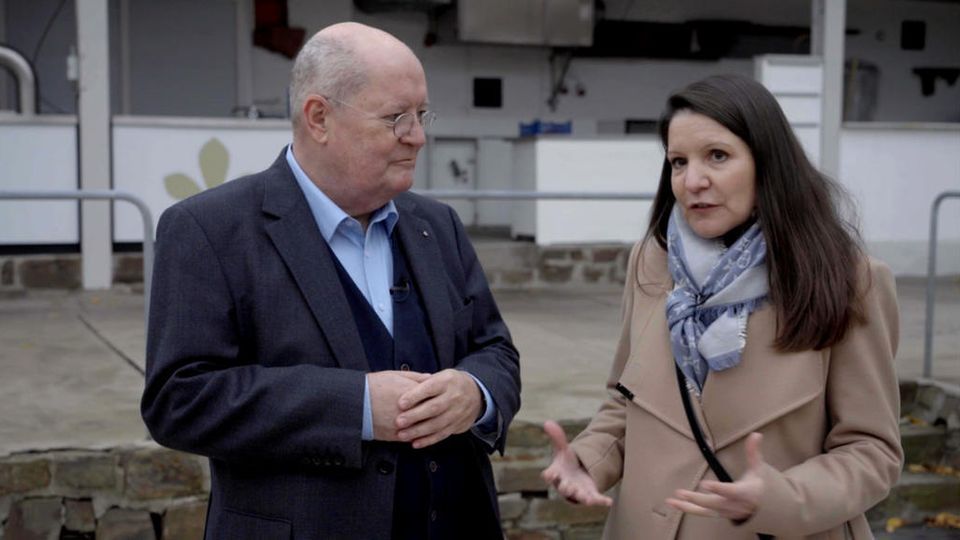
On the left: Fritz Dreesen
(the fourth generation)
On the right: Anna Maria Dreesen
(the fifth generation)
*****


