Sunday, November 6, 2016

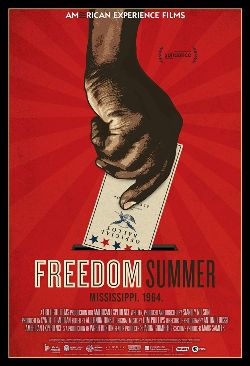
1964 - Freedom Summer: American Experience (2014)


Image result for freedom summer 2014 dvd cover


Freedom Summer – a documentary film about the civil rights campaign in Mississippi in the summer of 1964 – was shown on US television (PBS) in 2014. It is an episode of the long-running program American Experience (season 26, episode 6). Here is some basic information about it:

** Written, produced and directed by Stanley Nelson
** Original music composed by Tom Phillips
** Consultant: Bruce Watson
** Run time: 114 minutes

Many people were interviewed for this film. Many of them participated in the Freedom Summer campaign as organizers or volunteers. The list is quite long, but it is included here to illustrate how much work the filmmakers put into this product. Here are the names in the order of appearance:

** Gwendolyn Zoharah Simmons, volunteer
** Patti Miller, volunteer
** Tracy Sugarman (1921-2013), illustrator, volunteer
** Dorothy Zellner, organizer

** Larry Rubin, organizer
** Rita Schwerner, organizer
** Hollis Watkins, organizer
** Anthony Harris, Mississippi resident

** Bruce Watson, author
** William Winter, state treasurer
** William Scarborough, Citizens’ Council member
** John Dittmer, historian

** Charlie Cobb, organizer
** Julian Bond, organizer
** Eleanor Holmes Norton, organizer
** Ivanhoe Donaldson, organizer

** Robert “Bob” Moses, organizer
** Charles McLaurin, organizer
** Peggy Jean Connor, Mississippi resident
** Reverend Ed King

** Linda Wetmore Halpern, volunteer
** Susan Brownmiller, volunteer
** Chris Williams, volunteer
** Dave Dennis, organizer

** Daisy Harris, Mississippi resident
** Roscoe Jones, Mississippi resident
** Chris Hexter, volunteer
** Jan Nave Barnes, Miss Mississippi 1963

** Karin Kunstler Goldman, volunteer
** Pete Seeger (1919-2014), folk singer
** Sherwin Markman, convention delegate
** Taylor Branch, historian

Between the talking heads there is a lot of contemporary footage, photos and film. Since we are talking about the 1960s, all the old footage is in black-and-white. But we cannot complain about that.

The timing of this film is significant. It was shown in 2014 in order to mark the fifty-year anniversary of the Freedom Summer campaign that took place in Mississippi in 1964.

While the focus of the film is on the campaign of 1964, the film covers more than this. In order to provide some historical background and to explain how the campaign was prepared, the film begins around 1960 and ends in 1965.

The Freedom Summer was not about the right to sit at a lunch counter; nor was it about the right to have a seat on the bus. This campaign had a higher and wider objective. In fact there were three objectives which were closely intertwined:

# 1. Voter registration of the black population
# 2. Freedom schools for the black population, not only children but also adults
# 3. The all-white delegation to the Democratic Party convention in Atlantic City should be disqualified and replaced by an integrated delegation that was more representative of the people who lived in the state of Mississippi

The first part of the film focuses on objective # 1; the second part of the film focuses on objective # 2; the third part of the film focuses on objective # 3.

Almost 1,000 civil rights activists were sent to Mississippi. They came from many other states. Some activists were black, but most were white. Volunteers had to apply to take part in the campaign. Some applications were denied. The volunteers were carefully selected and prepared for the campaign.

The organizers wanted to be sure that the volunteers knew what they were getting into. Taking part in the Freedom Summer campaign was not only a serious matter, it was a dangerous matter. The danger was illustrated when three activists who had been in Neshoba County went missing in June 1964. Here are their names:

** Michael Schwerner
** Andrew Goodman
** James Earl Chaney

Schwerner and Goodman were white and from New York, while Chaney was black and from Mississippi. After a search which lasted 44 days the bodies of the three young men were discovered.

The killing of these men showed just how dangerous it could be to be a civil rights activist in the state of Mississippi. Schwerner’s widow Rita Schwerner is one of the many people who are interviewed in the film.

One name is mentioned several times in this film: Fannie Lou Hamer (1917-1977). Fannie Lou Hamer was a black woman from Mississippi, a sharecropper, who wanted to register as a voter. When she did, she lost her job. But she was not intimidated by this fact. She continued to work for civil rights.

She was a member of the Mississippi Freedom Democratic Party delegation that wanted to replace the all-white delegation in Atlantic City. President Johnson was afraid of her. He wanted to prevent her from addressing the convention in Atlantic City, but since he could not do that, he decided to call a last-minute press conference at the very moment when Fannie was going to address the convention.

Johnson knew the television stations would interrupt their coverage of the convention in order to cover his press conference. But his childish action backfired on him, because he had nothing to say at his press conference, and when the people of the press found out what he had done, Fannie’s speech was repeated in several news reports later in the day. In fact, her speech got more publicity than it would have if Johnson had just let her speak.

The Freedom Summer campaign was an important breakthrough for the Civil Rights Movement. In July, President Johnson signed the Civil Rights Act of 1964. In August of the following year, President Johnson signed the Voting Rights Act of 1965, which allowed every US citizen to register as a voter. No state was allowed to set up any bureaucratic obstacles if a US citizen wanted to register as a voter.

What do reviewers say about this film? On IMDb it has a rating of 84 per cent; on Rotten Tomatoes it has an audience score of 88 per cent. Both these ratings correspond to four stars on Amazon.

If you ask me, these average ratings are too low. Freedom Summer is a captivating, dramatic, and emotional film. It shows not only the importance of the campaign, but also the price the participants had to pay. I want to go all the way to the top with this product. I think it deserves a rating of five stars.

PS # 1. Stanley Nelson is also the writer and director of Freedom Riders, a documentary film about the Freedom Riders of 1961. His film about this campaign was shown on US television (PBS) in 2011, in order to mark the fifty-year anniversary of this chapter of US history.

PS # 2. Bruce Watson, consultant on the film and one of the many people who are interviewed in the film, is the author of the book Freedom Summer (2010, 2011).

PS # 3. Tracy Sugarman, one of the many people who are interviewed in the film, was an illustrator. Many of his drawings are shown in the film. He wrote a book about his experience in Mississippi which was published in 1966: Stranger at the Gates. It was reprinted in 2014.

PS # 4. Taylor Branch, one of the many people who are interviewed in the film, is the author of the book Pillar of Fire. It was first published in 1999.

PS # 5. The killing of the three civil rights activists in June 1964 is the subject of two movies and a documentary film:

** Mississippi Burning (1988, released on DVD in 2013)
** Murder in Mississippi (1990, released on DVD in 2008)
** Neshoba: The Price of Freedom (2008, released on DVD in 2010)

PS # 6. For information about Fannie Lou Hamer, see the following biography: For Freedom’s Sake: The Life of Fannie Lou Hamer by Chana Kai Lee (1999, 2000).

PS # 7. Sherwin Markman, one of the many people who are interviewed in the film, was a Special Assistant to President Johnson, 1966-1968. In May 2014 he gave a sermon about the summer of 1964 in a Maryland church. His sermon “Tragedy and Triumph: The Summer of 1964” is available online.

*****


Saturday, November 5, 2016

1961 - Freedom Riders: American Experience (2011)


Image result for freedom riders 2011 dvd cover


Freedom Riders - a documentary film about the Civil Rights Movement in the US - was shown on US television (PBS) in May 2011. It is an episode of the long-running program American Experience (season 23, episode 12). Here is some basic information about it:

** Written and directed by Stanley Nelson

** Produced by Stanley Nelson and Laurens Grant

** Run time: 115 minutes

The timing of the premiere is significant: Freedom Riders premiered in May 2011 in order to mark the 50-year anniversary of the first Freedom Ride which began in May 1961. The story of the Freedom Rides of 1961 is an important chapter in the history of the Civil Rights Movement in the US and this film tells it very well.

Freedom Riders were civil rights activists who travelled on interstate buses from the North to the South in order to test and challenge the rules and laws of segregation that were connected with transport in the southern states.

In 1946 the US Supreme Court had ruled that segregation on interstate buses was illegal. In 1960 the court had ruled that segregation in restaurants and waiting rooms in terminals that served interstate buses was illegal. But these rulings were ignored in the South and the federal government did not do anything to enforce them.

The first Freedom Ride was planned and organised by CORE, Council on Racial Equality. It was planned as a peaceful and non-violent campaign, but it was met with violence in the South. On 4 May, two small groups of activists boarded two regular buses in Washington, DC, bound for the South. According to the plan, they would reach New Orleans on 17 May. But things did not go according to the plan.

The operation became larger, lasted longer, and provoked more violence than anyone could ever have imagined. But it also made a huge impact on US society, North and South. The Freedom Rides did not end segregation, but they were an important element in the struggle against it.

PART ONE
More than thirty witnesses were interviewed for the film. Some of them were Freedom Riders, while others were residents of the South. In addition, there are a few experts who have studied the case for a long time. The list is quite long. It is included here in order to demonstrate how serious and comprehensive this investigation is. Here are the names in the order of appearance:

** Raymond Arsenault, historian, author

** Genevieve Houghton, Freedom Rider

** Gordon Carey, CORE staff


** Derek Catsam, historian, author

** John Lewis, Freedom Rider

** Diane Nash, student, Fisk University


** Charles Person, Freedom Rider

** Sangernetta Gilbert Bush, Montgomery resident

** John Seigenthaler, Nashville resident


** Evan Thomas, author

** John Patterson, governor of Alabama, 1959-1963

** Claiborne Carson, historian


** Julian Bond, Student Non-Violent Coordinating Committee (SNCC)

** Reverend James M. Lawson, Jr., Nashville Christian Leadership Council (NCLC)

** Jerry Ivor Moore, Freedom Rider

 
** Hank Thomas, Freedom Rider

** Moses J. Newson, journalist

** Mae F. Moultrie Howard, Freedom Rider

** Brandt Ayers, journalist

** Janie Forsyth McKinney, Anniston resident

** Gary Thomas Rowe, FBI informant


** Diane McWhorter, author

** Ted Gaffney, photographer

** Harris Wofford, assistant to President John F. Kennedy


** Jim Zwerg, exchange student, Fisk University

** Frederick Leonard, student, Tennessee State University

** Reverend C. T. Vivian, NCLC

** Bernard Lafayette, Jr., student, American Baptist Theological Seminary

** Catherine Burks-Brooks, Freedom Rider

** Delores Boyd, Montgomery resident


** Tommy Giles, aide to Governor Patterson

** Joan Mulholland, Freedom Rider

** Ernest “Rip” Patton, Jr., Freedom Rider


** Pauline Knight-Ofosu, Freedom Rider

** Rabbi Israel Dresner, Freedom Rider

** Glenda Gaither Davis, Freedom Rider

Throughout the film, interviews with witnesses are supplemented with clips from contemporary television reports which offer additional information about the development of the case. Obviously, most of these clips are from the US, but there are a few cases where we get to see a clip from the Soviet Union.

[Regarding John Seigenthaler (1927-2014): the first time we see him, he is merely identified as a Nashville resident. But as the story proceeds, we discover that he was much more than that: in 1961, he was assistant to Robert Kennedy, the Attorney General. He followed and observed the Freedom Riders and he regularly reported to Kennedy. At one point he was assumed to be a Freedom Rider as well and he was knocked out by an unknown assailant.]

PART TWO
The Freedom Riders were threatened, attacked, and jailed – just for riding on a bus from the North to the South. The response from the South was extremely violent. Freedom Riders were attacked by mobs of white people, while the local police force stood by, watching the violence, without intervening.

In some cases, the police would let the white mob operate without any restrictions for 10-15 minutes. After that they would say: “OK, this enough. Now you can stop.” Many Freedom Riders were arrested by the police for disturbing the peace. Some of them were sent to jail for several weeks.

The operation saw the federal government pitted against state governments. The leaders of the southern states wanted the Freedom Riders to go home, so that everything could return to normal. And the Kennedy brothers, i.e. the federal government, felt the same way. They did not support the Freedom Riders.

They thought the whole operation was a bad idea. In the film there is a clip where Robert Kennedy admits that the Freedom Riders have a legal right to take a bus to the South, but then he adds: “I question their wisdom.”

The Freedom Riders were threatened, attacked and jailed – but they did not give up. Whenever one group was arrested and sent to jail, another group would get on a bus and take their place. As the case rolled on, week after week, month after month, it became an embarrassment, not only to the federal government, but also to the local governments in the South. But the local governments did not want to give up, and the federal government seemed powerless to find a solution.

Even the Attorney General could not order the southern states to end segregation in the transport sector. The authority rested with the ICC, the Interstate Commerce Commission. Eventually, Robert Kennedy appealed to this body, which began to study the case.

Finally, on 22 September, the ICC ruled that there could be no segregation on interstate transport and no segregation in the terminals that were connected with interstate transport. All signs with “Whites” and “Colored” would have to come down. This ruling, effective from 1 November 1961, was a clear victory for the Freedom Riders, who had paid a high price to achieve this result.

In this film we follow the development of the case as it unfolds, day by day, week by week, month by month. We discover how different people and organisations respond to the case. We also discover how some of these people and organisations change their response to the case as it unfolds.

PART THREE
Freedom Riders got some good reviews: on IMDb it has a rating of 83 per cent. The film won three Prime Time Emmy Awards in 2011 and it won an Eddie Award from American Cinema Editors in 2012.

On the US version of Amazon, there are more than sixty reviews of this film. 96 per cent offer five stars. The remaining 4 per cent offer four stars. No reviewer wants to go lower than that. This pattern is quite unusual.

I understand the positive ratings and I agree with them. The positive reviews and the prestigious awards are fully justified. This is a film of high quality. The witnesses are well-chosen. Every witness makes an important contribution to the story.

The filmmakers have taken great care to ensure historical accuracy, and in most cases they have been successful. But, as noted on the IMDb website, there is at least one case where they used some old footage that was not from 1961:

“Some footage used about 40 minutes into the movie show Alabama State Trooper/Highway Patrol cars that clearly post-date the Spring/Summer 1961 Freedom Riders movement. One of the cars is a 1962 Plymouth and the other is a 1963 Chevrolet. The scene is used in context of the Freedom Riders arriving in Montgomery but apparently came from a later, unrelated incident.”

CONCLUSION
As you can see, there is a flaw, but only a minor one. Apart from this flaw, I think Freedom Riders can be described as an ABC-product: it is accurate, balanced and comprehensive. And therefore it is highly recommended.

PS # 1. For more information and background, see the following books, whose authors are interviewed in the film:

** Freedom Riders: 1961 and the Struggle for Racial Justice (2006, 2007) by Raymond Arsenault. In the credit rolls, he is listed as a senior consultant. The film is partly based on this book. Please note: there are two versions of this book. The original version has more than 700 pages. A shorter version was published in 2011. While it has more than 300 pages, it is still shorter than the original

** Freedom’s Main Line: The Journey to Reconciliation and the Freedom Rides (2009, 2011) by Derek Catsam

** Robert Kennedy (2000, 2002) by Evan Thomas

** Carry Me Home: Birmingham, Alabama: The Climactic Battle of the Civil Rights Revolution (2001, 2013) by Diane McWhorter

PS # 2. An Ordinary Hero is a documentary film about Joan Mulholland - one of the Freedom Riders interviewed by the PBS team - that was released in 2013.

PS # 3. For more details, see the following book: Breach of Peace: Portraits of the 1961 Mississippi Freedom Riders by Eric Etheridge (hardcover, large format, 2008).

*****