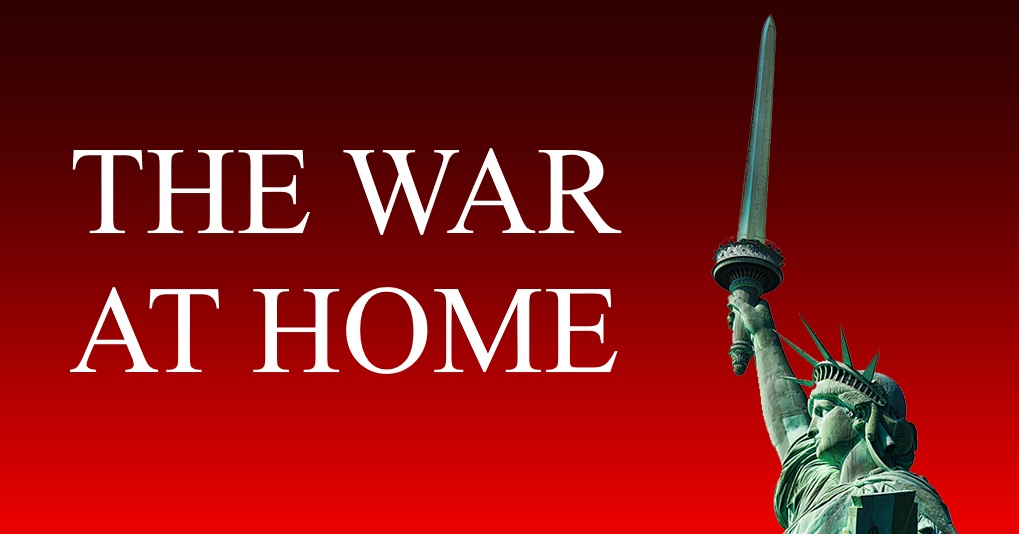
The War at Home (Part Two): Blacklist is a documentary film which premiered in 2021.
The topic is the untold history of class war in the United States.
Part Two covers the time from 1936 to 1956.
Here is some basic information about this film:
** Writer and director: Scott Noble
** Narrator: Mikela Jay
** Available on Films for Action
** Available on YouTube
** Subtitles: sadly, not available
** Run time: 119 minutes
Several persons are interviewed in the film. Here are the names of the participants (listed in alphabetical order):
** Noam Chomsky – Emeritus Professor of Linguistics – political activist – author of several books
** Andrew Cornell – author of Unruly Equality (2016)
** Nelson Lichtenstein – a labor historian
** Ellen Schrecker – author of The Age of McCarthyism (1994)
** Lance Selfa – author of The Democrats: A Critical History (2008)
** Christopher Simpson – author of The Science of Coercion (2015)
** Athan Theoharis – author of The FBI and American Democracy (2004)
Several cases and topics are covered in the film, including the following:
** The House Un-American Activities Committee (HUAC) (1938)
** The History of the Trade Union Congress of Industrial Organizations (CIO) (1935)
** The Little Steel Strike in Chicago (1937)
** The Federal Theater Project
** Cradle Will Rock (1937)
** The Rise of the FBI – Legal and Illegal Methods
** FBI Director = J. Edgar hoover
** American Corporations and their Connections with Nazi Germany before WW2
** The Smith Act (1940)
** The Cold War (1945-1990)
** The Threat of Nuclear War
** The Greek Civil War (1944-1949)
** The Rise of the CIA
** The National Security Council
** NSC-68 (a secret government document)
** The Taft-Hartley Act (1947)
** Blacklists
** The Hollywood 10
** The Rosenberg Case (1950-1953)
** McCarthyism (1950-1954)
Several labor organizers and political activists are presented, including the following:
** Farrell Dobbs (1907-1983)
A member of the Socialist Workers Party, who was arrested and convicted in 1941
** I. F. Stone (1907-1989)
An investigative reporter, who was editor and publisher of a newsletter I. F. Stone’s Weekly (1953-1971)
At the end of the film, the narrator explains that the FBI had established a secret program to monitor and harass American dissidents and to monitor, infiltrate and ultimately disrupt dissident organizations.
The narrator mentions the name of this program:
COINTELPRO
This word is the last word spoken in the film.
Director Scott Noble plans to release a third part of The War at Home. In this part, he will probably focus on the secret program COINTELPRO which was used against the political opposition from 1956 to 1971.
But Part Three has not yet been released. Apparently, Scott Noble needs more time and additional funds to produce the next installment.
♣♣♣♣♣
When we watch this film, we can see that the exploitation of the American working class was extreme. The American version of capitalism was brutal. While it produced amazing results for the upper levels of society, members of the working class paid a high price.
It was war; a constant war between the private corporations and the government against the working class. Hence the title of the film: The War at Home.
Most corporations demanded that the workers worked many hours six days a week.
Most corporations refused to pay a decent salary. Not even when profits were high.
For most corporations, health and safety in the work place was not a high priority. Thousands of workers were injured or killed on the job every year.
This film shows that the workers tried to organize. They tried to build trade unions in order to protect their lives and to improve their conditions.
They demanded that the number of working hours per day be reduced from ten (or more than that) to eight hours.
They demanded a decent salary.
They demanded that health and safety in the work place be given high priority.
But most corporations refused to accept these demands.
Most corporations were prepared to spend a lot of money on measures which would allow them to reject the demands of the workers
They hired private detectives to infiltrate and spy on trade unions; to intimidate and beat up leaders of trade unions.
Some corporations were prepared to hire a private army which was used to attack workers who were trying to build a trade union and to attack striking workers.
Corporations was supported by local law enforcement, by
local and federal politicians and by the judicial system and sometimes by federal troops.
Whenever trade unions were beginning to be
popular among the workers; whenever trade unions were beginning to gain some
power and some influence, the private corporations and the government went into action to make
sure that these trade unions were crushed or at least intimidated so much that the corporations could ignore the demands which were made by the trade unions.
♣♣♣♣♣
What do reviewers say about this film? This question is not easy to answer. It is listed on IMDb, but there is no rating; there are no customer reviews.
The IMDb website does not even indicate that this film was released in two installments: part one released in 2020 was followed by part two in 2021.
Part one is available on Top Documentary where it has a rating of 76 percent, but part two is not available on this website and therefore there is no rating.
What do I think about it? I think it is a powerful document about an important topic. The stories covered in this film are not well-known by the public. But they deserve to be told, and in this film, it is done very well.
I want to go all the way to the top with this product. I think it deserves a rating of five stars (100 percent).
REFERENCES
# 1. HUAC
** Hollywood and Anticommunism: HUAC and the Evolution of the Red Menace, 1935-1950 by John J. Gladchuk (2013)
** Showtrial: Hollywood, HUAC, and the Birth of the Blacklist by Thomas Doherty (2018)
# 2. The Little Steel Strike in 1937
** Blood on Steel: Chicago Steelworkers and the Strike of 1937 by Michael Dennis (2014)
** The Last Great Strike: Little Steel, the CIO and the Struggle for Labor Rights in New Deal America by Ahmed White (2016)
# 3. The Federal Theater Project (1937)
** Cradle Will Rock: The Movie and the Moment by Tim Robbins and Paul Newman (2000)
# 4. The FBI
** From the Secret Files of J. Edgar Hoover by Athan Theoharis (1993)
** Official and Confidential: The Secret Life of J. Edgar Hoover by Anthony Summers (2012)
# 5. American Corporations and their Connections with Nazi Germany before WW2
** Working for the Enemy: Ford, General Motors, and Forced Labor in Germany during the Second World War by Reinhold Billstein, Karola Fings, Anita Kugler, and Nicholas Levis (2000) (2004)
** General Motors and the Nazis: The Struggle for the Control of Opel, Europe’s Biggest Carmaker by Henry Ashby Turner, Jr. (2005)
** Nazi Nexus: America’s Corporate Connections to Hitler’s Holocaust by Edwin Black (2009)
** Hitler’s American Friends: The Third Reich’s Supporters in the United States by Bradley W. Hart (2018)
# 6. The Smith Act (1940)
** Cold War Political Justice: The Smith Act, the Communist Party and American Civil Liberties by Michal R. Belknap (1977)
** Freedom under Fire: US Civil Liberties in Times of War by Michael Linfield (1990)
** Perilous Times: Free Speech in Wartime – From the Sedition Act of 1798 to the War on Terrorism by Geoffrey R. Stone (2004)
# 7. NSC-68
** American Cold war Strategy: Interpreting NSC 68 by Ernest R. May (1993)
** NSC 68 and the Political Economy of the Early Cold War by Curt Cardwell (2011)
# 8. I. F. Stone
“All Governments Lie” - The Life and Times of Rebel Journalist I. F. Stone by Myra MacPherson (2010)
# 9. The Blacklist
** Blacklist by Sara Paretsky (2004)
** Film Criticism, the Cold War, and the Blacklist by Jeff Smith (2014)
** Radical Innocence: A Critical Study of the Hollywood Ten by Bernard F. Dick (2021)
# 10. Julius and Ethel Rosenberg (1950-1953)
** Final Verdict: What Really Happened in the Rosenberg Case by Walter Schneir (2010)
** Executing the Rosenbergs: Death and Diplomacy in a Cold War World by Lori Clune (2016)
** Ethel Rosenberg: An American Tragedy by Anne Sebba (2021)
# 11. McCarthyism 1950-1954
** McCarthyism and the Communist Scare in United States History by Karen Zeinert (2014)
** McCarthyism: The Realities, Delusions and Politics Behind the 1950s Red Scare by Jonathan Michaels (2017)
** Demagogue: The Life and Long Shadow of Senator Joe McCarthy by Larry Tye (2020)
# 12. Class War in the US
** A People’s History of the United States by Howard Zinn (1980) (2003) (2009)
** Revolts, Protests, Demonstrations, and Rebellions in American History: An Encyclopedia edited by Steven L. Danver (2010) (1,138 pages) (three volumes)
** A History of America in Ten Strikes by Eric Loomis (2018)
*****


