Wednesday, August 1, 2018

The Newspaperman (2017)


The Newspaperman: The Life and Times of Ben Bradlee Poster


The Newspaperman is a documentary film about the life and times of Ben Bradlee, who was for many years the editor of the Washington Post. Here is some basic information about this film which premiered in 2017:

** Director: John Maggio
** Narrator: Ben Bradlee
** Run time: 90 minutes

As stated above, this film is about the life of Ben Bradley (1921-2014), who was the editor of the Washington Post for more than twenty years (1968-1991). It is based on his autobiography A Good Life: Newspapering and Other Adventures (hardcover 1995, paperback 2017).

In the film, he is the narrator: he is reading short passages from his autobiography. Several other people are interviewed in the film. Here are their names in alphabetical order:

** Carl Bernstein
** Tom Brokaw
** Jim Lehrer
** Sally Quinn
** Bob Woodward

Among the many interesting cases mentioned in the film, two stand out, because the first one represents the high point of his career, and the second one represents the low point of his career.

# 1. The high point of his career is the time when Carl Bernstein and Bob Woodward investigated the break-in at Watergate and its ramifications. The investigation led them to the White House and to President Richard Nixon. The time was 1972-1974.

Week after week, the paper published stories about Watergate written by Bernstein and Woodward, even though most other media ignored the story, believing that there was nothing in it.

# 2. The low point in his career is the case of Janet Cooke, who was a reporter at the Washington Post. In 1980 she wrote a major story that was published in the paper. In 1981 her story won a Pulitzer Prize.

At first, it was a great honour for her and for the paper, but soon things began to change. Shortly after the announcement, it was discovered that the story was a fabrication, a product of the writer’s imagination!

This was a scandal in the media world. An embarrassment for the paper. How could this happen? How could the editor allow a false story to be printed? And how could a false story win a Pulitzer Prize?

What do reviewers say about this film? Here are the results of three review aggregators:

** 72 per cent = IMDb
** 80 per cent = Metacritic
** 94 per cent = Rotten Tomatoes

As you can see, the average ratings are quite good, quite high. But if you ask me, they are not high enough. I want to go all the way to the top with this product. I think it deserves a rating of five stars.

PS. For more information about the US media and the US government, see the following items:

** Tell the Truth and Run: George Seldes and the American Press (1996) (110 minutes). This film about George Seldes (1890-1995) is not available on Amazon UK.

** All Governments Lie: Truth, Deception, and the Spirit of I. F. Stone (2016) (88 minutes). This film about I. F. Stone (1907-1989) is available on Amazon Prime Video.

*****


 The cover of Ben Bradlee's autobiography:

A Good Life (1995, 2017)

*****


Sunday, July 15, 2018

Peace, Propaganda & the Promised Land (2005)


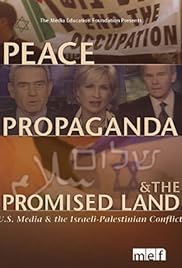
Peace, Propaganda & the Promised Land Poster


Peace, Propaganda & the Promised Land is a documentary film about the U.S. media and the Israeli-Palestinian conflict. Here is some basic information about this film which premiered in 2005:

** Writers and directors: Sut Jhally & Batsheba Ratzkoff
** Producer: Media Education Foundation (MEP)
** Run time: ca 80 minutes

Several people were interviewed for the film. Here are their names in alphabetical order:

** Seth Ackerman
** Stav Adivi
** Arik Asherman
** Hanan Ashrawi
** Noam Chomsky

** Robert Fisk
** Neve Gordon
** Toufic Haddad
** Sam Husseini
** Hussein Ibish

** Robert Jensen
** Michael Lerner
** Karen Pfeifer
** Alisa Solomon
** Gila Svirsky

This film takes a clear stand on the topic at hand:

# 1. The US news media tend to present Israel in a positive light, while the Palestinians are usually presented in a bad light.

# 2. The version that is offered by the US media is often incomplete or misleading and in some cases completely false, because it ignores important historical facts and turns reality upside down.

How does it happen?

The language is very important:

** The US media will not talk about Israel’s “occupation” of Palestinian land. They will not describe the occupation as “illegal.” But there is an occupation, and it is a violation of international law.

** The US media will not talk about “a Jewish settlement,” because this word may have negative associations. Instead they will talk about “a Jewish neighborhood,” because this word has positive connotations.

** When there is a violent clash between the two sides, the US media will say that Israeli troops are trying to “defend themselves against a Palestinian attack.” They will not say the opposite: that the Palestinians are trying to “defend themselves against an Israeli attack.”

** When Israel makes a proposal to the Palestinian side, the US media will describe it as “a generous peace offer.” When the Palestinians turn down the offer, the US media will use this fact to say that the Palestinians do not want peace. But if you study the details of the Israeli proposal, you will find that the offer is not generous at all and that the Palestinians have a good reason to turn down the offer.

One of the persons who are interviewed in the film uses an image to explain the conflict between Israel and the Palestinians. Let us say we have a house with a basement, ground floor and first floor. Family A lives in this house. One day, family B decides to invade the house. They take over the first floor completely; they take over half of the ground floor and half of the basement. Then family B says to family A:

“You can have one room in the basement and one room on the ground floor. We will take over the rest of the house. Please remember, we control the staircase. When you want to go from the basement to the ground floor, or the other way, you must pass a checkpoint. Show your passport and your permit. We also control the bathroom. When you wish to use the bathroom, you must pass a checkpoint. Show your passport and your permit. We think this is a generous offer. Please sign this contract to confirm that you accept this offer.”

Family A is the Palestinian population in the occupied territories, while family B is the Israeli invasion of the occupied territories: Jewish settlers supported by the Israeli army.

This is what the situation looks like when it is seen from the Palestinian side. Do you think the actions of family B are right? Can you understand that the members of family A are unhappy with the situation and that they do not want to accept the contract that is offered by family B?

The Israeli-Palestinian conflict is highly controversial. Many people have strong feelings about it, even if they have no personal connections to this conflict.

Some people will like this film, because they agree with what is being said, while other people will hate it, because they disagree with what is being said. Whether you agree with the film or not, I think it is worth watching, because it has some important information.

What do reviewers say about it? Here are the results of three review aggregators:

** 57 per cent = Metacritic
** 64 per cent = Rotten Tomatoes
** 83 per cent = IMDb

As you can see, the average ratings are quite good, quite high. But if you ask me, they are not high enough. I want to go all the way to the top with this product. I think it deserves a rating of five stars.

PS # 1. For more information, see the following items:

** Stone Cold Justice (2014)

** The Occupation of the American Mind (2016)

PS # 2. American Radical: The Trials of Norman Finkelstein is a documentary film about the (highly controversial) US scholar Norman Finkelstein, who has written extensively about Israel and the Palestinians. The film premiered in 2009.

*****